August 2026 recap: what agents asked us to build, and where AI actually lands next
The four things agents actually asked for in August, what we shipped against them, and the honest version of what AI does and does not change about a real estate website.


This is our recap of August 2026: what came up over and over on strategy calls, what we actually built against it, and what we think is worth planning for as the year runs out.
One thing shaped almost every conversation. Agents are no longer asking whether to use AI. They are asking which parts of their business it should be anywhere near, which is a much better question and a much harder one to answer honestly.
1. Speed stopped being a technical detail
August was the month page speed came up unprompted, from agents rather than from us. Not as a Core Web Vitals score, which almost nobody mentions by name, but as a complaint: my site feels slow on my phone and I do not know why.
The cause was nearly always the same. A heavy third party search widget, a hero image straight off a camera, and a stack of tracking scripts, each defensible on its own and collectively fatal. We spent more of August removing things from sites than adding them.
2. Neighborhood pages, not city pages
The agents having the best organic month were not ranking for their metro. They were ranking for one subdivision, one school boundary, one new build community, and they got there with a handful of genuinely detailed pages rather than forty thin ones.
This is the least glamorous work we do and it keeps outperforming everything else. A page that actually answers what it is like to live somewhere will outrank a portal listing for that neighborhood, because the portal cannot write it.
3. Search that belongs to the agent
Ari Bhattacharjee's site is the clearest version of this we have built. His San Diego search runs on his own domain across the full county feed, with the map and the property cards side by side and filters that apply in place, so a buyer can run five searches without the site fighting them.
What made it come up repeatedly in August is what happens after the search. Every saved search and every favorited property lands with Ari rather than with whoever bought the ad slot next to the listing. Several conversations this month started with an agent describing that outcome before they described a design preference.
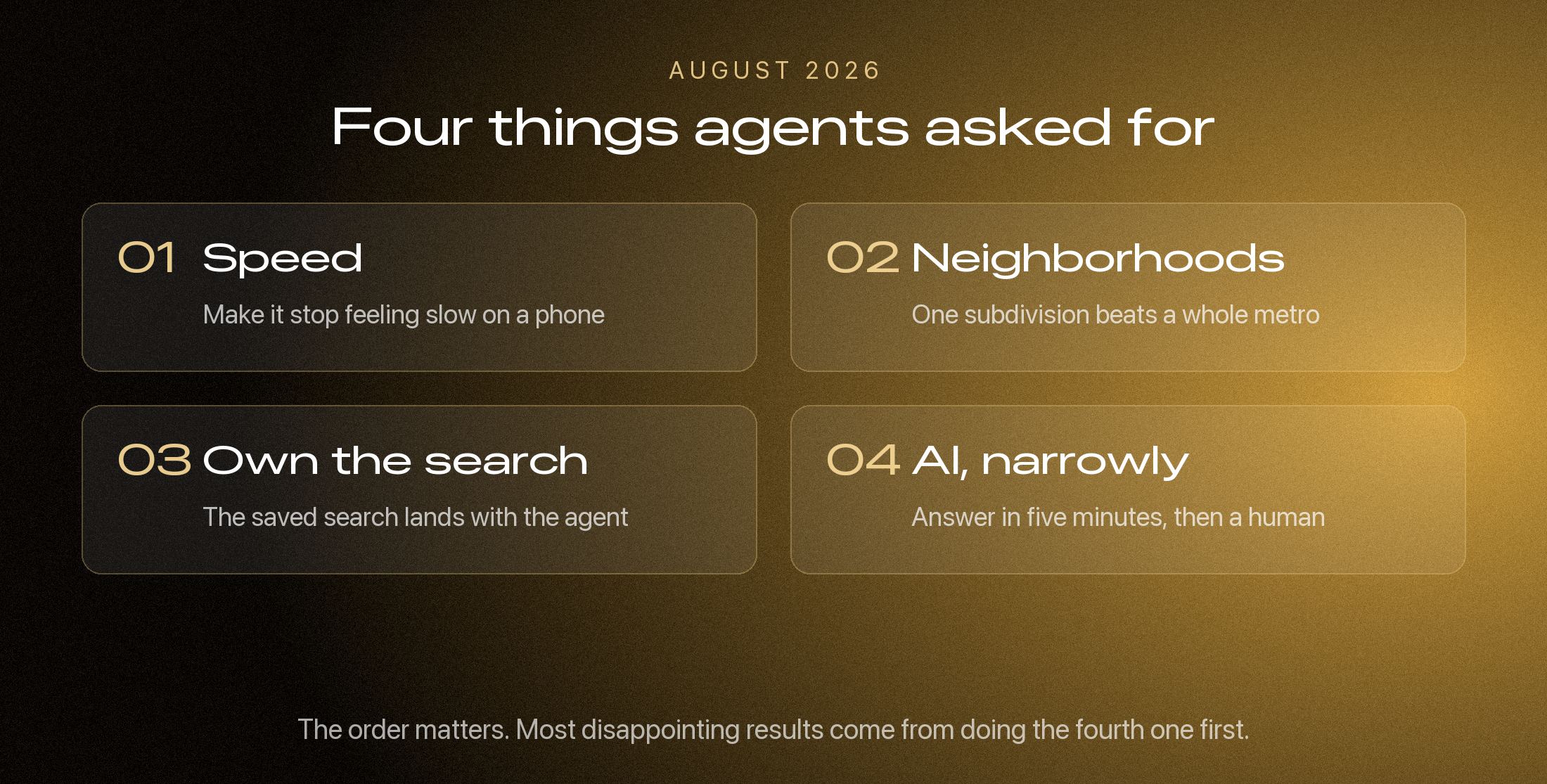
4. AI, minus the pitch
Here is our honest read, since the marketing around this has gotten loud. AI is genuinely good at the part of the job that happens in the first five minutes: acknowledging an inquiry immediately, asking the two obvious qualifying questions, offering times that are actually free on your calendar, and making sure nothing sits unanswered overnight.
It is not good at the part you are hired for. It cannot tell a seller their price expectation is wrong, read a room during a listing presentation, or judge whether a buyer is talking themselves into a house they will regret. Every deployment we have seen fail was one that pointed AI at the second category instead of the first.
Use AI to make sure nobody waits. Do not use it to make sure nobody talks to you.
The other shift is on the search side, and it is the one we would plan around. A growing share of buyers now ask an AI assistant a question before they ever open a search engine, and the answer it gives cites a handful of sources. Being one of those sources is a different job from ranking, and it rewards the same things good neighborhood pages already do: specific, structured, genuinely informative writing that is easy for a machine to quote correctly.
What did not change
Worth saying, because a recap that only lists shifts implies everything is in motion. The things that decided whether a site worked in August are the same ones that decided it in February. Photography that is actually yours. Copy that sounds like the person who wrote it. A clear reason to call you rather than the next agent. No amount of tooling substitutes for any of those.
The agents who had a good month were not the ones with the most technology attached to their site. They were the ones whose site made an argument, with the technology quietly making sure that argument reached someone quickly.
What we would tell an agent planning September
Fix speed first, because it is cheap and it gates everything else. Then pick two neighborhoods you actually know and build the pages properly rather than building twelve you cannot maintain. Put the search on your own domain. Then, and only then, wire AI into the follow up so nothing waits on you overnight.
That order matters more than any individual item on it. Most of the disappointing results we hear about come from doing the fourth thing first.