
Commercial and investment web architecture: how high-volume producers showcase portfolios and attract capital
Investors and institutional partners do not shop the way home buyers do. What a commercial real estate website has to show, and why a residential template works against you.


What makes a commercial real estate website different from a residential one?
A commercial real estate website has to establish institutional credibility and present financial facts, where a residential site sells a home and a neighborhood. Investors, tenants, and capital partners look for track record, asset metrics such as cap rate and net operating income, a clear record of closed deals, and a controlled way to review offering documents. A good commercial site puts those first and routes each inquiry according to what the person is looking to do.
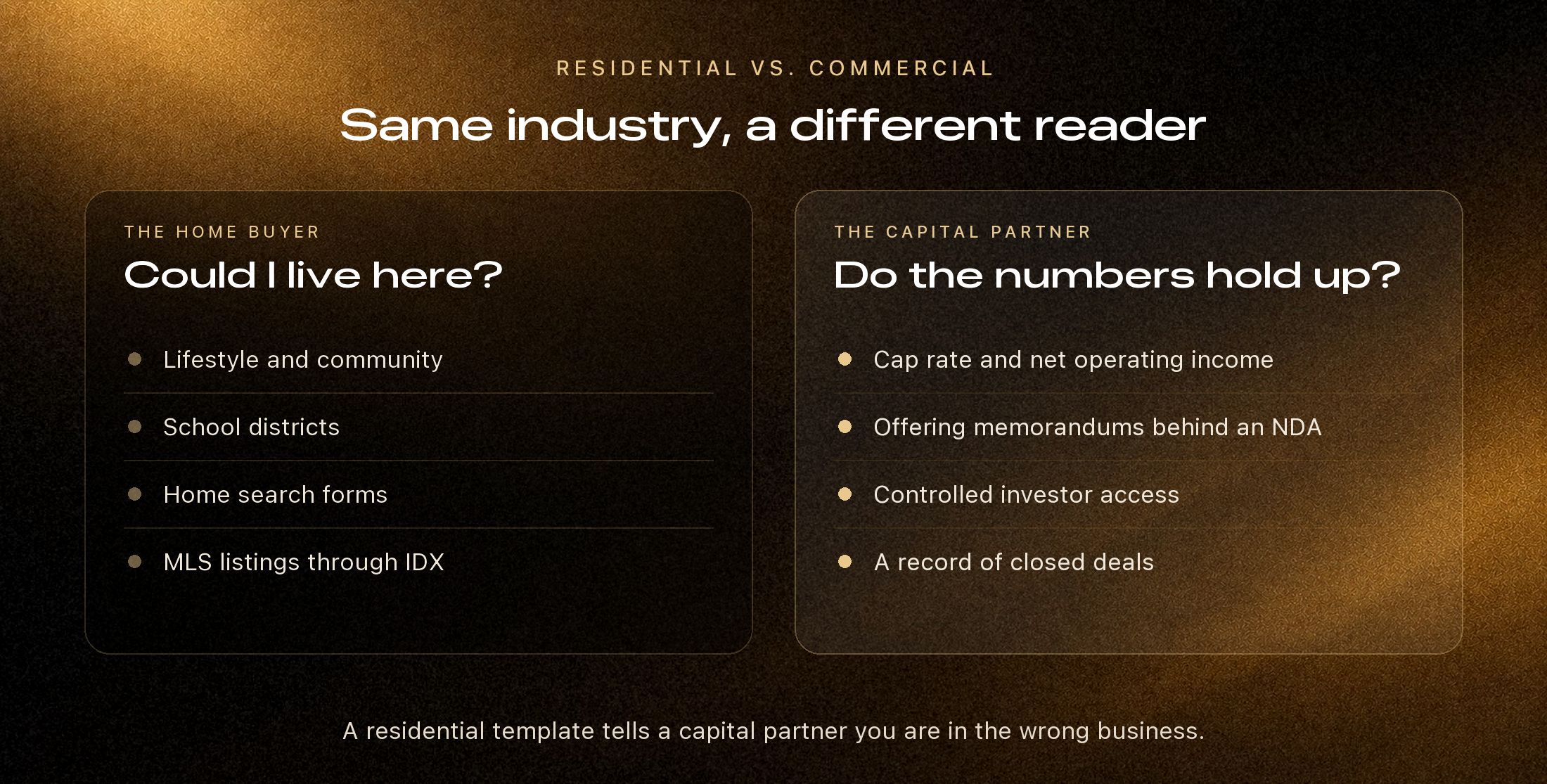
Residential sites run on lifestyle: the kitchen, the school district, how the street feels on a Saturday. Commercial decisions run on a different set of questions. Can this group execute, what have they closed, and do the numbers hold up?
That is why a broker or investment group marketing multifamily, retail, or industrial assets on a residential template starts at a disadvantage. The hero photo, the home search box, and the neighborhood guides all signal the wrong line of business to the person deciding whether to take a meeting.
The three pillars of a commercial website
1. A structured deal-flow portfolio
Institutional visitors want to see acquisitions, completed developments, and transaction volume quickly. A portfolio grid that filters by asset type (multifamily, industrial, retail, development land) and by status (active offering, under contract, closed) answers that in a few clicks. Each asset gets its own page with location, size, and the figures you are comfortable publishing.
2. A gated offering memorandum flow
Sensitive financials should not sit on an open page. A visitor signs a short NDA or completes an investor profile, then unlocks the offering memorandum, financial model, and lease roll for that asset. You protect the deal, and you learn exactly who is reviewing which opportunity. This is one place a gate belongs, because the document is worth the exchange and the reader expects it.
3. Investor intake connected to your CRM
A contact form that sends everyone to one inbox wastes a partner's time. An intake form can capture investment criteria, target return, check size, and timeline, then send the inquiry into the right CRM pipeline, so that the first call starts with a qualified conversation.
If you are raising capital, have your securities counsel review this part of the site before launch. What you may publish about an offering, and who you may market it to, depends on the exemption you are relying on. The website should be built around that answer.
How the two kinds of site compare
| Residential site | Commercial site | |
|---|---|---|
| Main question | Could I live here? | Do the numbers and the sponsor hold up? |
| Inventory | MLS listings through IDX | Your own portfolio, by asset type and status |
| Key document | Rarely more than a listing sheet | Offering memorandum behind an NDA |
| Lead form asks for | Name, phone, and home search details | Criteria, target return, and timeline |
3
Pillars of a commercial website
2
Filters that matter first: asset type and status
1
NDA between a qualified visitor and the full OM
On a commercial site, the design is a due diligence signal. It is often the first one a partner sees.
Credibility is the conversion
Whether you are marketing one large asset or running an active investment group, your website often gets reviewed before anyone agrees to a call. A clear record of closed deals, well-presented assets, and a professional way to request documents all make that call easier to win.
Clozma designs custom websites around the way your business actually runs, including portfolio pages, gated document flows, and CRM intake. Book a demo to talk through your portfolio.