How ChatGPT and Google AI recommend realtors: generative engine optimization and schema markup for real estate
Buyers now ask AI assistants who the best agent in town is. What generative engine optimization means for a real estate website, and the schema markup that makes you citable.
What is generative engine optimization in real estate?
Generative engine optimization, or GEO, is the work of structuring a real estate website so AI search tools like ChatGPT, Perplexity, and Google AI Overviews can read it, verify who you are, and cite you by name when someone asks for an agent in your market. In practice it means JSON-LD schema markup, a business identity that matches everywhere it appears online, and specific, well organized local content an AI can quote accurately.
Buyers and sellers are no longer only typing two word searches into Google. More and more of them are asking an assistant a full question: who is the best agent in Frisco for golf course homes, or which San Diego agents specialize in first time buyers. The assistant writes an answer, and that answer cites a handful of sources.
If your website is not one of the sources it can read and trust, you are not in the answer at all. The portals usually are, which is how an agent with twenty years in a neighborhood loses a recommendation to a Zillow page.
How this differs from the SEO you already know
| Traditional SEO | Generative search | |
|---|---|---|
| The goal | Rank for a short keyword | Be cited inside a written answer |
| What is rewarded | Links and keyword coverage | Verifiable identity and clear, quotable facts |
| Who reads the page | A person, after the click | A machine first, then maybe a person |
| What the content looks like | Articles written around keywords | Direct answers, structured data, specific local detail |
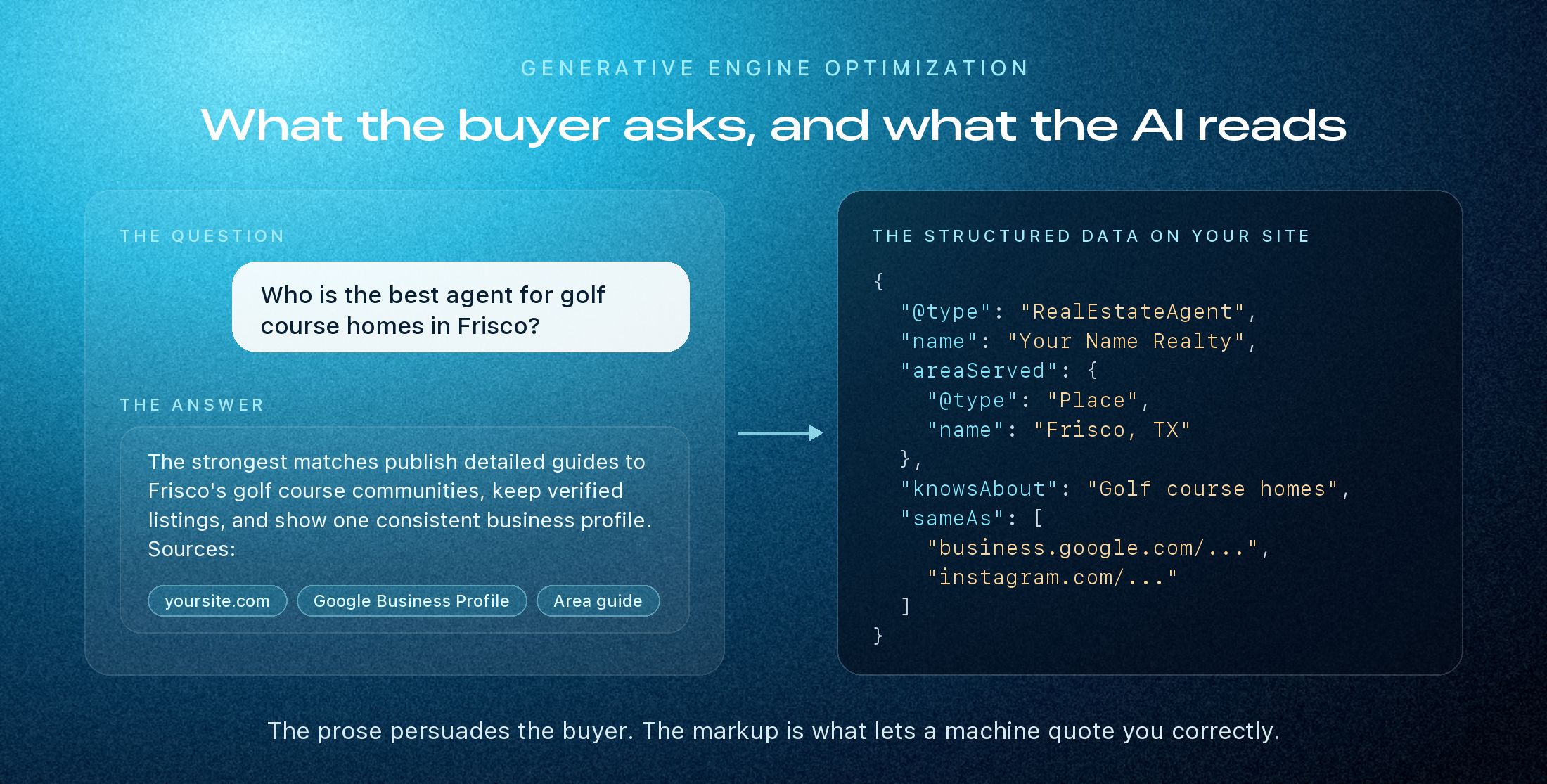
The three schema types a real estate site needs
Schema markup is a block of structured data, usually JSON-LD, that tells search engines and AI models what your content means rather than leaving them to infer it from the prose. It is invisible to visitors and reads to a machine like a fact sheet.
- 1
RealEstateAgent. A schema.org type built for exactly this, a kind of local business. It states your business name, logo, address, phone, the areas you serve, and links to your verified profiles elsewhere, which is the core of how a machine decides you are one real entity.
- 2
SingleFamilyResidence and Offer. On listing and property pages, these describe the home itself and the terms it is offered on: price, size, and availability. They make property details unambiguous rather than something scraped out of a paragraph.
- 3
Place and PostalAddress. On neighborhood and community pages, these tie your content to specific places, so the page is understood as being about that subdivision or school boundary rather than about real estate in general.
To be clear about what this does and does not do: schema does not guarantee you are cited, and no one can promise that. It removes ambiguity, which makes it far more likely a machine represents you correctly when it does draw on your site.
How AI tools decide which agent to recommend
- Entity verification. Can the model connect your website, your Google Business Profile, your social accounts, and any press or directory mentions into one consistent business? A name spelled three different ways across the web reads as three different businesses.
- Structured data completeness. Does your site state the facts that answer the question, your service area, your specialties, your contact details, in markup a machine can read without guessing?
- Experience and expertise. Does the site carry original material only you could have written: case studies, detailed neighborhood guides, real transaction experience? This is the E-E-A-T standard Google describes, and AI answers lean on the same signals.
An AI cannot recommend you if it cannot tell who you are, and it will not quote you if there is nothing specific to quote.
What to fix first
Start with consistency, because it costs nothing. Make your business name, phone number, and address identical on your website, your Google Business Profile, and every profile you control. Then make sure your site says, in plain text on the page, which areas you serve and what you specialize in, so there is something to cite.
After that, the markup and the structure. RealEstateAgent schema sitewide, Place markup on neighborhood pages, and a clear hierarchy of pages that answer the real questions buyers ask about your market, each one in a sentence or two that could be lifted into an answer intact.
3
Schema types every agent site should carry
1
Business identity, spelled the same everywhere
2-3
Neighborhood guides worth starting with
How Clozma builds for AI search
Every site we build ships with structured data from day one: the business schema, per page markup for articles, neighborhoods, and listings, and a site structure designed for machines to read as well as people. We also publish a plain text summary for AI crawlers alongside it. The design is what wins over the person. The structure underneath is what gets you into the conversation before they ever arrive.