Why your website is winning, or losing, the listing presentation before you step foot in the home
Sellers run a silent digital audit before they open the door. What they find on your domain decides how much authority you carry into the living room.
Homes are not selling overnight any more. With average days on market stretching to fifty and sixty in many major metros and inventory stabilizing, sellers are anxious in a way they were not two years ago.
When a homeowner decides to interview agents to market the most valuable thing they own, they do something before you ever arrive at their door. They run a silent digital audit.
This happens even when you were referred. A trusted neighbor gives them your name, and then they search it anyway. What they find on your domain sets how much authority you carry into that living room, and it is settled before you shake a hand.
80%+
Of sellers search an agent before meeting
50-60
Average days on market in major metros
1st
Impression is now your website, not you
The hidden cost of the twenty dollar template
Suppose a seller searches your name and lands on the generic site your brokerage portal handed you, or on a cheap builder template. Consider what that actually communicates, because it communicates something whether you intend it or not.
The representation gap
A seller listing at 750k or 1.5M wants an agent who knows how to market an asset at that price. If your own website looks like a digital business card from 2018, they are left with a quiet, unflattering question: if this is how they present their own brand, how are they going to present my home?
The me-too trap
When your site uses the same stock photography, the same layout, and the same typeface as five hundred other agents in your city, you have made yourself a commodity. Commodities get asked to justify their commission. Brands get asked when you can list.
The proof paradox
High value sellers are not really evaluating your website. They are evaluating how you showcase a home, and your website is the only sample of that work they can see unsupervised. A custom, design-first site lets that sample include video headers, neighborhood context, and bespoke listing showcases, which is marketing sophistication demonstrated rather than claimed.
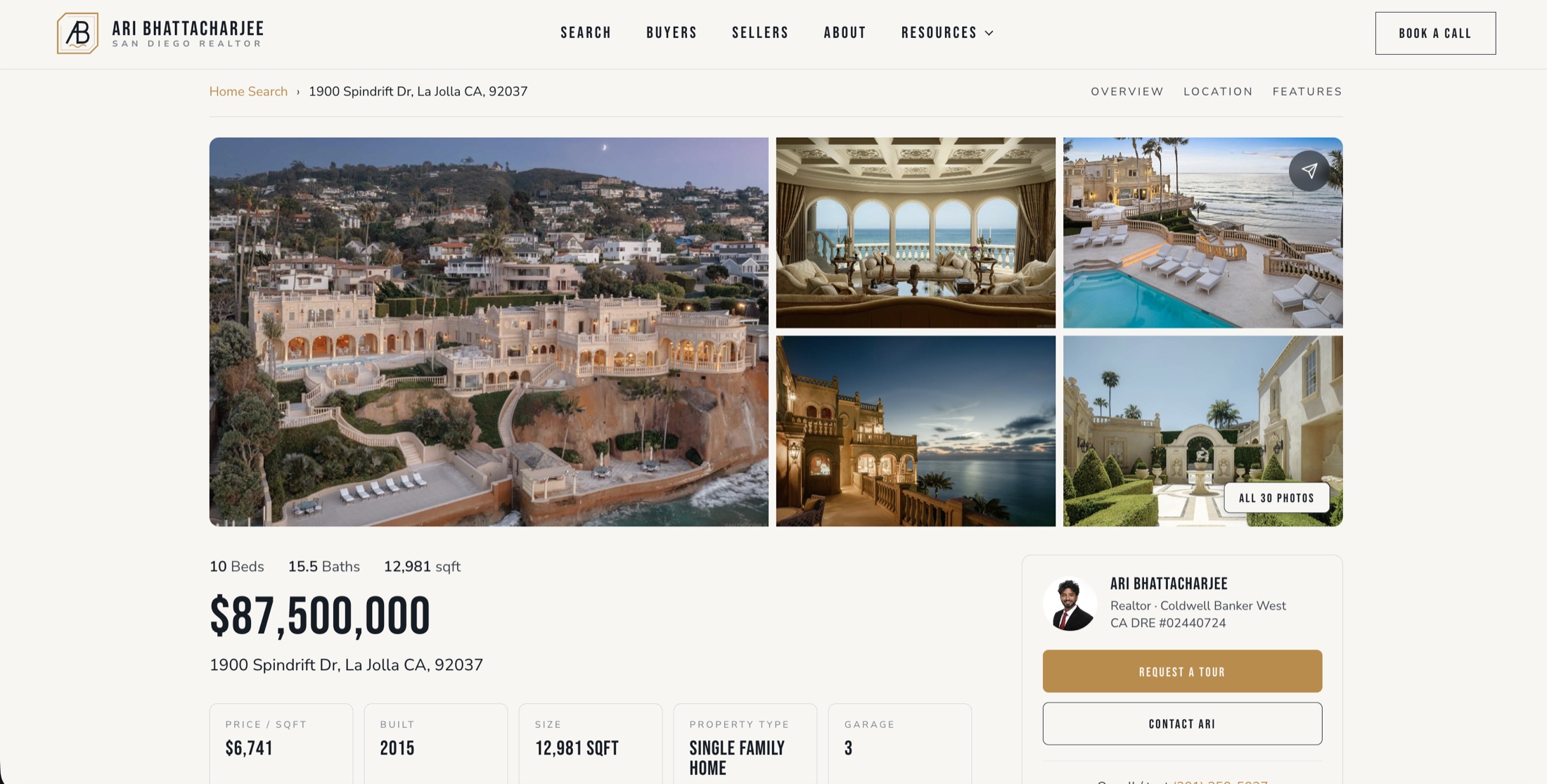
A seller comparing three agents remembers the one whose marketing looked like it belonged to the price point of their house.
Your website is the listing presentation
The reframe worth making is that this is not an online business card that supports your pitch. In a market where sellers vet privately before making contact, it is the pitch, and the meeting is where you confirm what they already decided.
That changes what belongs on it.
- 1
Single-property showcase pages so that instead of telling a seller their home goes on the MLS, you can open a page you built for the last one, with the 3D tour, the neighborhood story, and its own lead capture.
- 2
Neighborhood hubs for the areas you actually work which prove you dominate their subdivision or ZIP code rather than asserting it, and which pull targeted buyer traffic to your domain in the meantime.
- 3
Clean typography and fast mobile load because psychological safety is built from small signals, and a page that loads instantly and reads cleanly on a phone creates more of it than any paragraph about your credentials.
- 4
Proof placed where doubt occurs meaning results and past marketing sit next to the claim they support, not quarantined on a testimonials page nobody opens.
The bottom line
In a balanced market, listings do not go to the agent with the most yard signs from five years ago. They go to the agent who presents the most credible professional image today, and for most sellers that image is now a screen.
So the question is worth asking directly. Is your website helping you win listings, or is it quietly losing them before you arrive?