The iframe IDX trap: why your website's MLS search may be giving your SEO to someone else
Almost every agent website advertises full MLS search. How that search is built decides who gets the search credit, where your buyers end up, and how fast the page loads.
What is the difference between native IDX and iframe IDX?
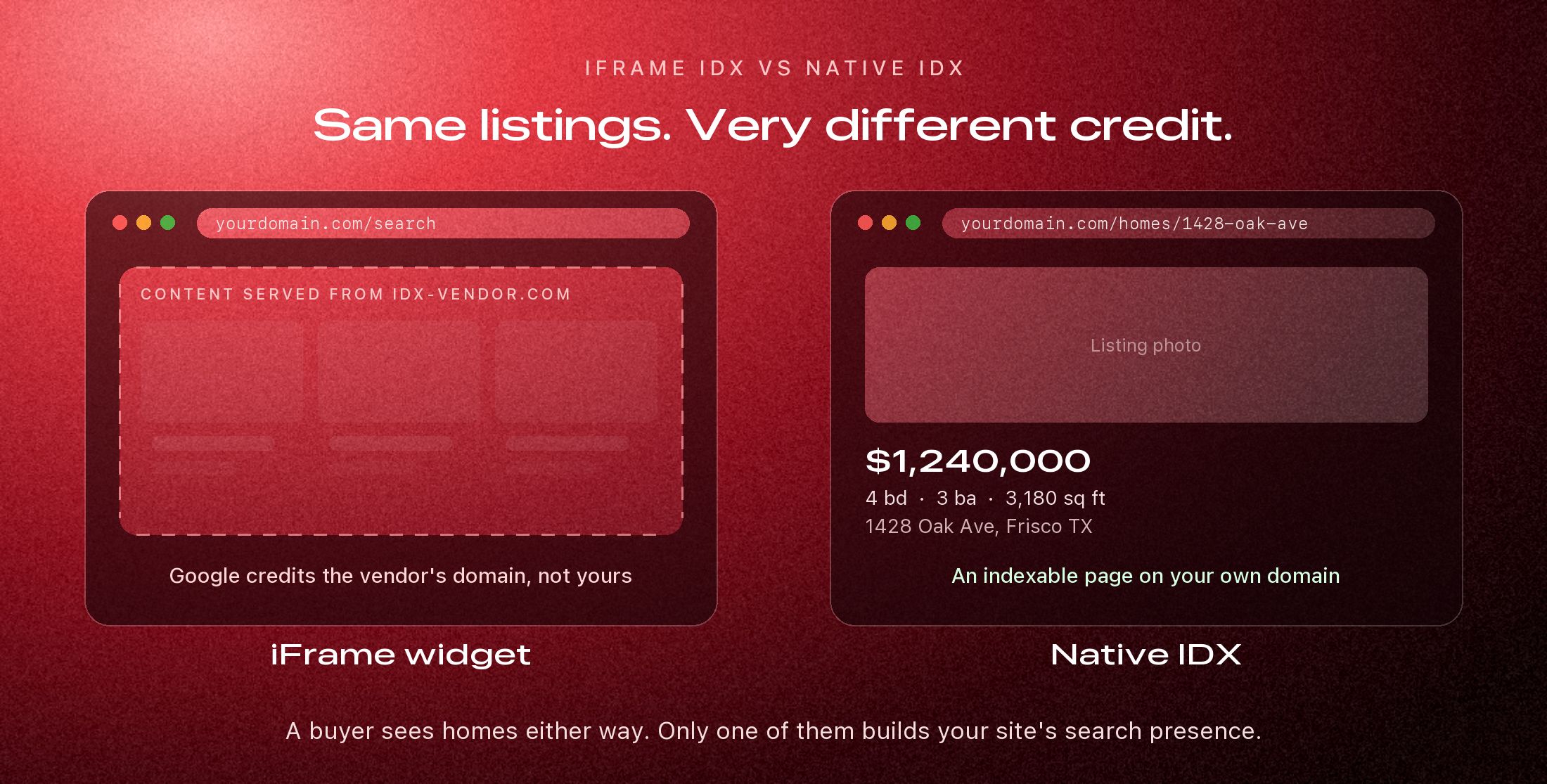
Native IDX builds MLS listings into your website itself, under your own domain, so each property can have its own page at an address like yourdomain.com/homes/1428-oak-ave that search engines can crawl and credit to you. Iframe IDX embeds a window onto your page that loads content from the IDX vendor's server. Visitors see listings either way, but search engines attribute iframed content to the vendor's domain rather than to yours, so your site earns little or no search credit for it.
Shop for a real estate website builder and almost every one of them promises full IDX and MLS search. What the sales page rarely tells you is how that search is integrated, and that detail decides a lot more than it sounds like it should.
A large share of template platforms deliver search as an iframe: a rectangle cut into your page, showing content that lives on someone else's server. A buyer can browse homes in it perfectly well. What they are browsing, as far as a search engine is concerned, is not your website.
Why the iframe gives the credit away
Search engines can often read what is inside an iframe, but they treat it as belonging to the page it came from. The listings, the addresses, the neighborhood names, and every bit of keyword rich text in that panel count toward the vendor's domain. Your page is credited with the frame around it.
| Iframe widget | Native IDX on your domain | |
|---|---|---|
| Where listing pages live | The vendor's server | yourdomain.com |
| Who search engines credit | The vendor's domain | Your domain |
| Where shared links send people | Often a third party address | Back to your site |
| How it loads on a phone | A second page loading inside yours | Part of the page from the first paint |
Three costs of the iframe, in order of how much they hurt
1. Search presence that accrues to someone else
With native IDX, active listings can exist as real pages on your domain, each with its own address, street name, subdivision, and price in the page itself. With an iframe, a search engine sees one page on your site with a window in it. Every street name a buyer might search is sitting inside that window, working for the vendor.
2. Buyers leaking back to the portals
A buyer finds a home in your iframe and texts the link to their partner. Depending on how the widget is built, that link can point at the vendor's address rather than yours, so the partner lands somewhere that does not carry your name, and the next search happens on Zillow. The lead you paid to attract has been handed to whoever bought the ad slot next to the listing.
3. A slower, jumpier page on mobile
An iframe is a second page loading inside yours, with its own scripts and its own styling. It tends to arrive late and push the layout down when it does, which is exactly the layout shift Core Web Vitals penalize, and it is felt most on a phone on a cellular connection, which is where most home searching happens.
You are paying for the search either way. The only question is whose website it is building.
The honest caveat about listing pages
Native IDX is not a ranking cheat code, and anyone who tells you it is should be treated carefully. The same MLS listing appears on every agent site in the market and on every portal, so a bare listing page is duplicate content, and search engines have little reason to rank yours first.
What native IDX does is make those pages yours to improve. When listing pages sit on your domain, they can link to your neighborhood guides, carry your own notes on the street and the school boundary, and feed the local authority you are building everywhere else on the site. An iframe cannot do any of that, because none of it is on your site to begin with.
What it looks like in practice
When we built Ari Bhattacharjee's San Diego site, the search went directly onto his own domain, aribrealty.com, running across more than 50,000 live listings. Buyers search, save, and request tours without ever leaving his site, and every saved search, favorite, and tour request goes to Ari alone rather than to a portal's lead marketplace.
50,000+
Live listings searchable on Ari's own domain
1
Domain every saved search and tour lands on
0
Third party lead reselling
How to tell which one you have
Open a listing in your site's search and look at the address bar. If it still shows your domain and a path that describes the property, you are probably on something native. If the URL is someone else's, or the address bar never changes while the listing changes, the search is almost certainly an iframe.
Then share a listing link with yourself and open it on another phone. Where it lands is where your buyers' partners, parents, and friends are landing too.
Turn the search into an asset
Clozma builds custom websites with live native IDX on your own domain, designed to match the rest of your site rather than parked inside it. Your search should build your business, not a vendor's.