
July 2026 recap: the month agent websites stopped chasing the portals
Four shifts we watched play out across agent websites in July, and what they change about the sites worth building in August.

This is our recap of July 2026: what came up repeatedly in strategy calls, what we ended up building, and what we would tell an agent planning a rebuild in August.
The theme running under all of it has nothing to do with design. It is that almost nobody starts a home search on an agent's website any more. They start on the portals, and by the time they reach your site they have already seen the inventory.
That reframes the whole job. Your website is not competing to be a search engine. It is competing to be the reason someone picks you, which is a different design problem, and July was the month it stopped being a debate in the rooms we were in.
What we heard from agents in July
Three behaviors came up in nearly every conversation. Buyers arrive already informed and want interpretation rather than listings. Sellers research the agent far more than the process, and they do it privately before making contact. And a growing share of serious buyers are moving between metros, which means they need context about neighborhoods more than they need another search field.
The sites winning that traffic answer the question the portals cannot: what is it actually like to live here, and is this person the right guide.
Four things we built or rebuilt in July
1. Hyper-local area pages that are worth reading
Most of the area pages we touched in July went the same direction: the standard city page replaced by neighborhood-level pages with original photography, honest commentary on trade-offs, current inventory, and a clear sense of who the area suits. These take real work, which is exactly why they rank. They are also the most durable SEO asset an agent can own, because a competitor cannot generate them from a template.
2. Relocation and niche hubs
Every relocation hub we shipped in July followed the same rule: one page, one audience, no hedging. The three that consistently pay for themselves are out-of-state relocation, new construction, and luxury sellers. Each gets its own page, its own proof, and its own call to action, rather than being folded into a generic services section.
3. Booking that happens on the page
We retired the form-then-wait pattern on every build that went out in July. Live availability sits directly in the layout and the meeting is confirmed before the visitor leaves, which converts far better than a contact form promising a callback. The design constraint is that the scheduler has to look like it belongs to the site rather than like a widget borrowed from another company.
4. Follow-up that runs while you are showing
This was the most requested change in July, and it is a design requirement now rather than an operations detail. A lead that arrives at nine at night and hears nothing until morning is usually gone. The sites that convert are wired so the first reply goes out in seconds and the qualification happens before the agent picks up the thread.
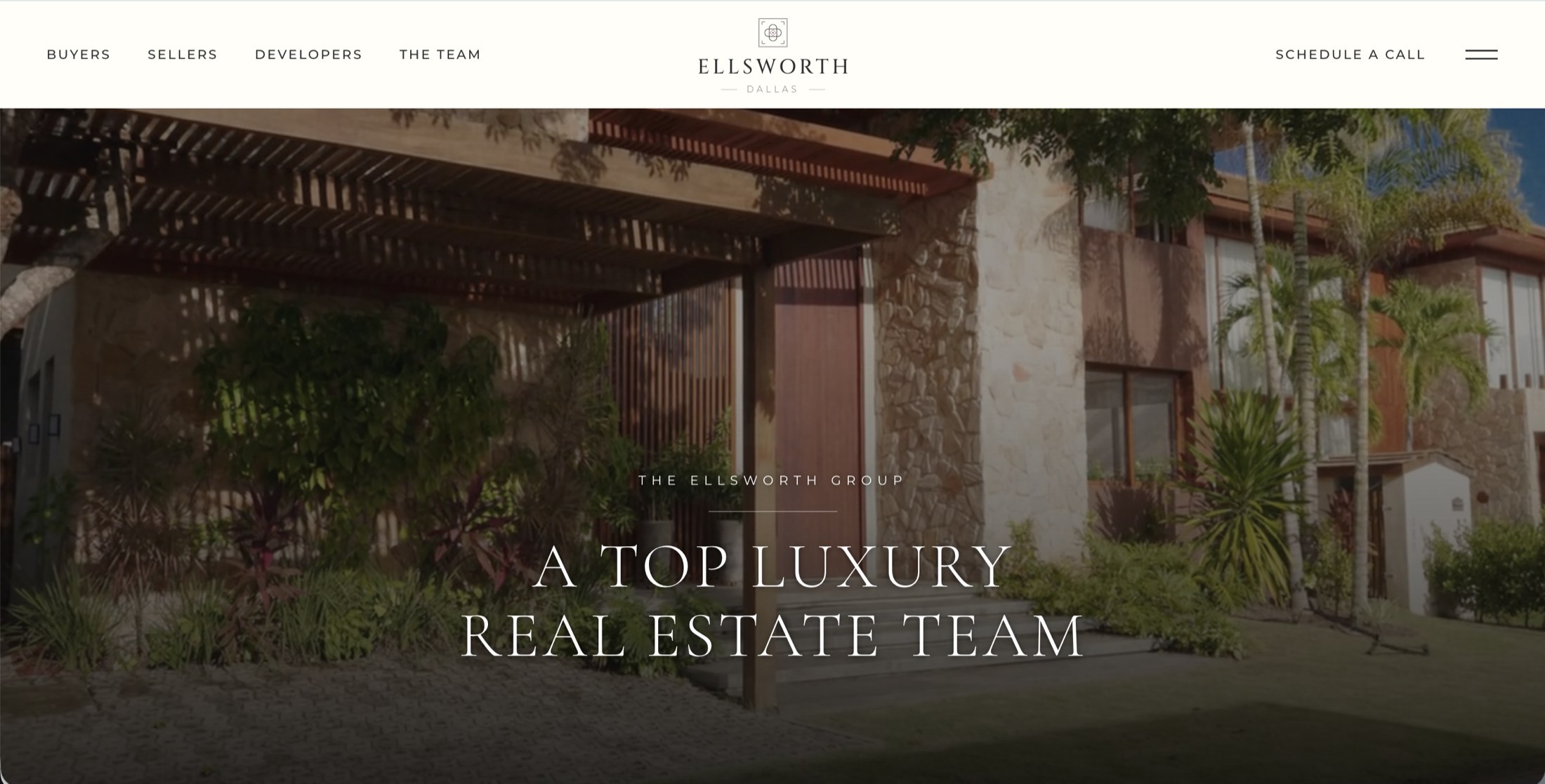
The July listing-presentation pattern
The most useful thing we learned in July came from watching how agents actually use the sites we build. They pull them up on a tablet mid-presentation and use them as the proof point. The site is the portfolio, which is the practical reason design budget keeps climbing at the top of the market. It is not vanity.
When your website is part of the pitch, it stops being marketing overhead and starts being the thing that closes the listing.
A seller comparing three agents will remember the one whose marketing looked like it belonged to the price point of their house. That is a design outcome, and it is measurable in listings won.
What to prioritize if you are rebuilding in August
- 1
Brand and typography first because every other decision inherits from it, and it is the cheapest thing to get right at the start and the most expensive to retrofit.
- 2
Two or three deep neighborhood pages rather than twenty thin ones. Depth ranks and thin pages actively hurt you.
- 3
One niche hub that matches your actual book of business whether that is relocation, new construction, or luxury sellers.
- 4
Booking and instant follow-up wired in from day one so the traffic the first three steps earn does not leak out the bottom.
July in one line
The agents who had a good July stopped trying to out-search the portals and started building sites that do the one job a portal cannot do, which is make a case for a specific person. That is a design problem, a content problem, and a follow-up problem, in that order. We expect to be writing the same sentence in August.