The relocation effect: why out-of-state buyers choose the agent with the best local digital presence
An out-of-state buyer cannot drive past your office or read your yard signs. Your website is one hundred percent of their experience of your brand.
One of the largest shifts in the current market has nothing to do with rates. It is domestic migration: thousands of families a week leaving dense, high tax metros for growth corridors in Texas, Florida, the Carolinas, and Tennessee.
Relocation buyers are the client most agents say they want. They are highly motivated, financially qualified, working to a deadline, and frequently buying at a higher price point than the local median.
They also require a completely different website from the one that serves your local buyers, and this is where most agents in high growth markets quietly lose them.
Your website is the entire relationship
A local buyer accumulates impressions of you over months. They pass your sign on the way to work, they see you at an open house, a neighbor mentions your name. None of that exists for a family in New Jersey deciding between Frisco and Prosper.
They cannot drive by your office. They will not see a yard sign. Your website is not part of their experience of your brand, it is the whole of it, and it is carrying the job that a year of local presence would normally do.
An out-of-state buyer is not comparing your website to other websites. They are comparing it to every other signal they do not have.
Relocation buyers do not start with listings
This is the detail that changes the design brief. A local buyer often starts with inventory, because they already understand the geography. A relocation buyer starts with the geography, because they do not.
The questions they are actually asking, in order, look like this:
- What is it genuinely like to live in this neighborhood compared to that one, beyond the marketing language?
- Which communities have the amenities and the school access we need, and what are the trade-offs?
- What does a 750k home look like in this suburb compared to what 750k buys back home?
- How long is the commute, actually, at the hour I would be driving it?
Now consider what happens when that buyer lands on a site whose homepage is a photograph and a raw MLS search box. They leave, and they are right to. A grid of listings answers none of those four questions. It assumes context the visitor does not have.
Building a hyper-local discovery hub
The fix is not more listings on the page. It is treating the website as a discovery tool for the place rather than a catalogue of the inventory. Three things do most of the work.
1. Neighborhood guides worth reading
Not a paragraph of text under a stock photo. A real guide covers the architectural styles you actually find there, the school district picture, what the commute looks like in both directions, who the area tends to suit, and where it falls short. Original photography matters here more than anywhere else on the site, because the visitor has never seen the street.
These pages are also the most durable search asset an agent can own in a migration market, precisely because a competitor cannot generate them from a template.
2. Dedicated relocation funnels, one page per origin
A page titled Moving from New York to North Dallas will out-convert a general relocation page every time, because it can be specific about the things that page cannot: the property tax difference, what the lack of a state income tax actually nets out to, lot sizes, insurance, and which local assumptions do not transfer.
Pick the two or three origin markets that already show up in your business and build one page each. Do not build twelve thin ones.
3. A virtual experience with no friction in it
Relocation buyers run on video walkthroughs and remote consultations, often across time zones. Booking needs to happen on the page with live availability rather than through a form that promises a callback, tour video needs to sit in the layout rather than behind a link, and the whole sequence needs to work on a phone at an airport.
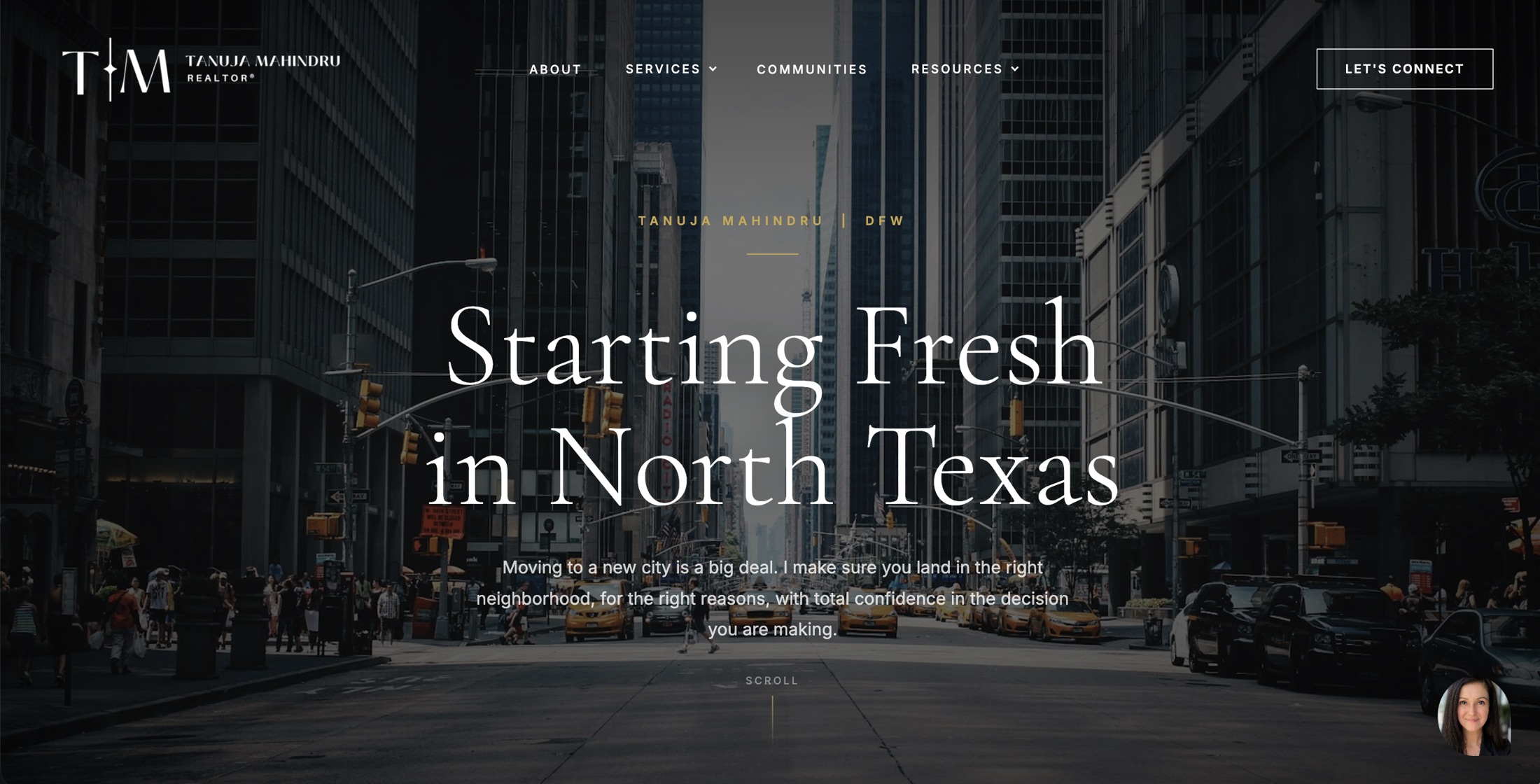
Why design carries more weight with this buyer
Buyers leaving major wealth centers arrive with calibrated expectations about digital quality, set by everything else they use. A slow, cluttered, dated site does not read to them as a small business being frugal. It reads as a mismatch with the level of service they are expecting to buy.
That judgment gets made in a few seconds, before a single word of your copy has been read, and there is no local reputation in the background to override it.