
September 2026 recap: the fall market shift, AI search wins, and what we are building for Q4
What we measured across client sites in September: more serious sellers, AI assistants sending real traffic, and mobile at its highest share yet. Plus what we are building for Q4.

This is our recap of September 2026: what we measured across the client sites we run, what our clients did that worked, and what we are building for the last quarter of the year.
September is a transition month. The summer rush settles, the visitors who remain are more deliberate, and the questions they bring to a website change. Fewer people are browsing. More of them are deciding.
One note on the numbers below. They come from our own client sites, compared with the month before, and they are a small network rather than an industry survey. Treat them as what we saw, not as what the whole market did.
1. Fall sellers arrived, and they wanted a number
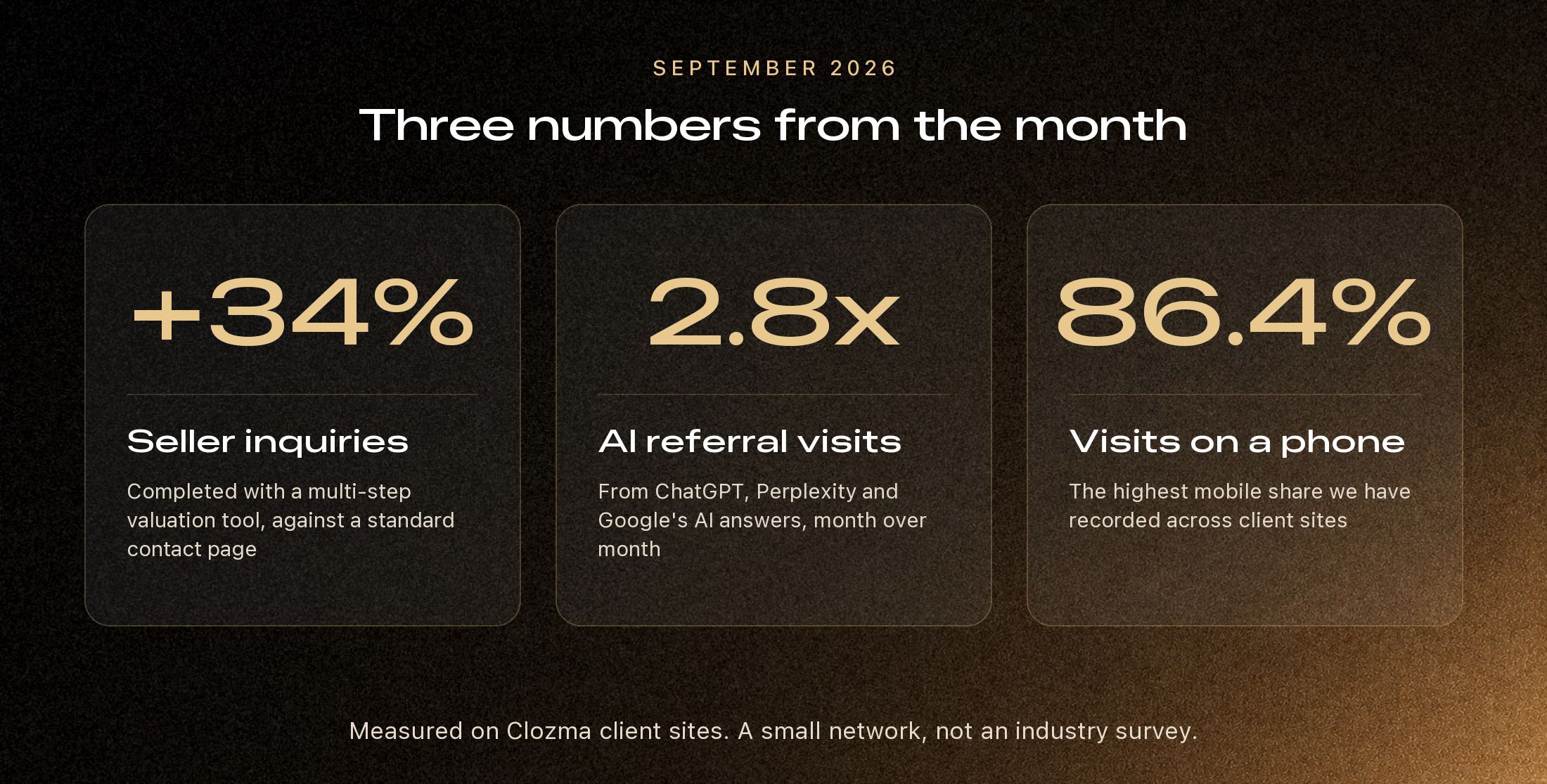
Homeowners visiting our clients' sites in September were noticeably more serious about finding out what their home is worth before the year ends. The pattern showed up in which pages they used. Sites with a proper multi-step valuation tool recorded 34% more completed seller inquiries than sites sending the same visitor to a standard contact page.
The reason is the one we keep coming back to. A valuation tool asks for one thing first, the address, and gives something back before it asks for more. A contact form asks for everything and promises a reply. In a month when sellers were ready to act, that difference decided who heard from them.
2. AI assistants started sending real traffic
This was the month AI search stopped being a forecast in our reporting. Client sites built with structured data saw referral visits from AI platforms, ChatGPT, Perplexity, and Google's AI answers among them, rise 2.8x over August.
The absolute numbers are still small next to ordinary search, and we would not tell anyone to plan a business around them yet. What matters is the direction, and what the visits have in common: they land on pages that state plainly who the agent is, where they work, and what they know. An assistant asked about new builds in a specific town cites the site that answers that question in a sentence it can quote.
3. Mobile reached its highest share yet
Across the network, 86.4% of visits in September happened on a phone. That is the highest figure we have recorded, and it turns a design preference into arithmetic. If a page works on a laptop and is merely acceptable on a phone, it is merely acceptable for almost everyone.
The sites that converted best were the ones with a sticky action bar: call, text, and book a tour, within thumb reach on every page. Sites that left those actions in a footer menu asked visitors to scroll to the bottom of a long page to do the one thing the page exists for.
+34%
Completed seller inquiries with a valuation tool
2.8x
AI referral visits, month over month
86.4%
Share of visits on a phone
What our clients did that worked
Local authority, one town at a time
Mesaynish Wodajo's Dallas site carries dedicated guides to Addison, Richardson, Irving, and Celina, and those pages kept doing quiet work all month. They are where relocating buyers land, because someone moving to North Texas from another state searches for the town before they search for an agent.
Search that stays on the agent's domain
Ari Bhattacharjee's San Diego search runs on his own domain rather than in a third party window, and the difference shows in how long people stay. Across our clients, buyers on sites with native search stayed roughly three times longer than on sites still using an embedded widget. Time on site is not the goal in itself. It is the evidence that the search is good enough to keep using.
Saying the offer plainly
The sites that did best with sellers were the ones that stated what the agent does and what it costs to find out, in high contrast type, near the top of the page. September rewarded clarity. A homeowner deciding whether to list before the holidays does not read three paragraphs to find the button.
Fewer visitors, more of them serious. September is the month a website gets judged on whether it can take yes for an answer.
What we are building for Q4
- 1
Search in plain sentences. We are working on search bars that accept a full request, four bedrooms near a good elementary school under a set price, instead of making a buyer translate that into six dropdowns.
- 2
Interactive tools in place of PDF guides. Relocation and cost calculators that give an answer on the page and tell the agent what the buyer actually needs, replacing downloads nobody opens.
- 3
One consistent identity everywhere. Making sure each client's structured data, Google Business Profile, and social profiles describe the same business in the same words, which is what AI recommendations depend on.
What we would tell an agent planning Q4
Put a real valuation tool where your contact form is, because the sellers visiting now are the ones listing in early 2027. Check your site on your own phone before you check it anywhere else. And make sure the page says, in plain text, which towns you work in and what you specialize in, so there is something for a person or a machine to quote.
None of that is new advice. September was simply the month the numbers made the case for it more loudly than we could.